
Best CCTV Systems for Industrial Sites and Warehouses in Hyderabad
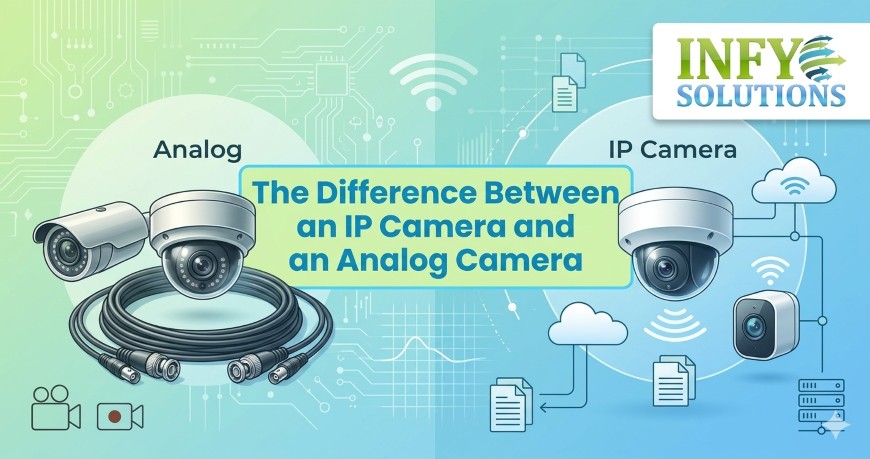
In today’s security-conscious world, choosing the right surveillance system is crucial for homes and businesses. One of the most common questions people ask is about The Difference Between an IP Camera and an Analog Camera. Understanding this difference helps you make informed decisions when investing in a CCTV surveillance system.
Both camera types serve the same purpose-monitoring and recording activities-but they differ significantly in technology, performance, and functionality. At Infyc Solutions, we provide a wide range of surveillance solutions, including analog HD CCTV surveillance systems, network / IP CCTV surveillance systems, and Wi-Fi Camera setups tailored to your needs.
Let’s explore the key differences in detail.
To better understand The Difference Between an IP Camera and an Analog Camera
It’s important to know how each system works.
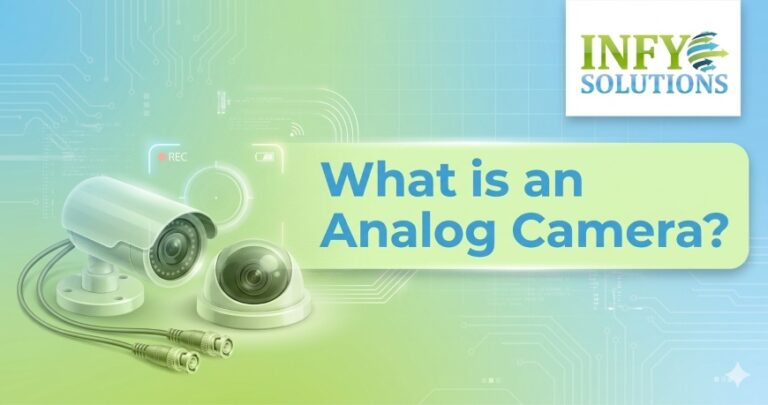
An analog camera captures video and transmits it as an analog signal through coaxial cables to a digital video recorder (DVR). These cameras are widely used in traditional CCTV surveillance systems due to their simplicity and affordability.
Modern upgrades like the Analog HD CCTV Surveillance System allow analog cameras to deliver high-definition video without replacing existing cabling.
An IP (Internet Protocol) camera captures and transmits video data over a network. It connects directly to the internet or a local network, making it a core component of a network for IP CCTV surveillance.
By integrating with Wi-Fi camera technology, IP cameras enable wireless connectivity and allow remote access from smartphones or computers.
Understanding The Difference Between an IP Camera and an Analog Camera
becomes clearer when comparing their features:
IP cameras are ideal for environments requiring detailed footage, while analog cameras suit basic surveillance needs.
Analog systems are easier to install, whereas IP systems may require network configuration but offer more flexibility.
For small businesses, analog systems are often preferred, while larger enterprises opt for IP-based solutions.
IP cameras, especially Wi-Fi camera setups, allow users to monitor their property from anywhere.
Businesses planning future expansion often choose a network/ IP CCTV surveillance system for easy upgrades.
Even with modern alternatives, analog cameras remain relevant. Here’s why:
These benefits make analog cameras ideal for small-scale setups and budget-conscious users.
IP cameras are gaining popularity due to their advanced capabilities:
At Infyc Solutions, we help clients choose the right network / IP CCTV surveillance system based on their specific requirements.
When deciding between an IP camera and an analog camera, your choice should depend on the following factors:
If cost is a concern, analog cameras are a practical choice.
For high-security environments, IP cameras provide better clarity and advanced features.
Analog cameras work well in existing setups, while IP cameras are ideal for new installations.
If you require remote access, IP or Wi-Fi camera systems are the best option.
Both camera types are widely used across different sectors:
Homeowners often use analog cameras for basic monitoring or upgrade to Wi-Fi camera systems for remote access.
Businesses use a mix of analog and IP cameras in CCTV surveillance systems to ensure comprehensive coverage.
Factories and warehouses prefer IP cameras for large-scale monitoring and scalability.
Shops use analog systems for affordability and IP systems for advanced analytics.
Today’s security systems use more than one technology. Many businesses combine both:
This hybrid approach allows businesses to leverage the benefits of both technologies.
When exploring, partnering with the right service provider is essential.
Infyc Solutions offers The Difference Between an IP Camera and an Analog Camera:
Our expert team ensures seamless installation, reliable performance, and ongoing support.
Understanding The Difference Between an IP Camera and an analog camera is essential when choosing a surveillance system. While analog cameras offer affordability and simplicity, IP cameras provide advanced features and superior performance.
The right choice depends on your budget, security needs, and future scalability. Whether you need a basic setup or a high-tech surveillance system, both options have their advantages.
Looking for the best surveillance solution for your home or business? Infyc Solutions is here to help you choose the right system based on your needs.
From CCTV surveillance system installations to advanced network/IP CCTV surveillance systems and Wi-Fi camera solutions, we provide end-to-end security services.
Contact Infyc Solutions today and secure your property with the latest surveillance technology!
Infy Solutions explains the difference between an IP camera and an analog camera based on technology, video quality, and connectivity.
Infy Solutions highlights the difference between an IP camera and an analog camera, where IP cameras provide higher resolution and clarity.
Infy Solutions explains the difference between an IP camera and an analog camera, helping users choose based on features and needs.
Infy Solutions explains the difference between an IP camera and an analog camera, noting IP cameras need internet, but analog does not.
Infy Solutions explains the difference between an IP camera and an analog camera, showing that analog systems are more



Copyright © 2026 INFYC Solutions | Designed by Web Rocz